Wednesday, September 12, 2012

IGB REIT IPO Oversubscribed by 21.75 times

IGB REIT IPO Oversubscribed by 21.75 times: Pavilion REIT (Real Estate Investment Trust) Initial Public Offering (IPO) received an overwhelming response with its public portion of 34  million units. It was oversubscribed by 21.75times. The IPO attracted 32,781 applications or 773.6 million units. In addition, 24.5 million units initially set aside for eligible directors and employees were made available for Malaysian Public. Institutional [...]

[[ This is a content summary only. Visit my website for full links, other content, and more! ]]

Monday, September 10, 2012

Bonds & Sukuk for Retail Investors

Bonds & Sukuk for Retail Investors: Recently, Securities Commission Malaysia (SC) launched the Malaysian retail bonds and sukuk framework that allows retail investors to directly invest in bonds and sukuk. The framework is part of the initiative under the SC’s Capital Market Masterplan 2 to facilitate greater retail participation in the bond and sukuk market. The retail bonds and sukuk framework [...]

[[ This is a content summary only. Visit my website for full links, other content, and more! ]]

Download Alternative Investment Strategies And Risk Management ...

Download Alternative Investment Strategies And <b>Risk Management</b> <b>...</b>: Alternative Investment Strategies And Risk Management by Raghurami Reddy Etukuru Mba Caia Alternative Investment Strategies And Risk Management plo. ... In addition to hedge funds, you will find information and guidance on various phases of due diligence; risk metrics, quantitative models and exotic options; commodities, managed futures, private equities, and real estate; brokers, auditors, and legal counsel. Get the information you need to make informed ...

Is Tesco Mounting A Recovery?

Is Tesco Mounting A Recovery?:

Is Tesco Mounting
A Recovery?
  • Tesco shares have rebounded from their recent low
  • Recent sales figures look more encouraging
  • Its digital investment seems to be paying off
Monday, 10th September 2012
Dear Collective Reader,
It came out of the blue, slashing nearly a quarter off the share price in one fell swoop.Tesco’s (LSE: TSCO) profit warning in January, its first for 20 years, divided investors between bulls, who saw it as a temporary glitch, and bears, who saw more serious writing on the wall.
It wasn’t just among private investors that opinions were sharply divided. Investment guru Warren Buffett rapidly upped his stake in the company to over 5%, while high-yield fund management superstar Neil Woodford took a more pessimistic view, selling out completely. Our analysts at Motley Fool Share Advisor have also been watching the business closely, as it has the sort of dominant market position we love to see.
So how is Tesco faring now?
As far as the share price goes, there has been a little recovery. Tesco shares are up about 15% since the end of May, when they briefly dipped below £3. They have also outpaced the FTSE 100 index of leading UK shares by over 10% over the last six months.
That said, at around 345p, the shares are still some 15% below the level they enjoyed in January, before the aforementioned profit warning.
Hubris
Tesco’s sin was one of hubris, perhaps not surprising in the light of former CEO Terry Leahy’s very long and successful tenure. It took its core UK grocery business for granted, and neglected it in favour of exciting growth opportunities internationally and in non-food business, from out-of-town hypermarkets to banking.
Nemesis came when the UK shopper woke up to Tesco’s poorer customer service and product offering, and its grocery market share slipped. Meanwhile, the new markets proved tough.
Internationally, Tesco lacks the market power it has at home, hypermarkets found online competition tougher than was expected, and some new domestic ventures, such as second-hand cars, were just a step too far.
Tesco’s act of repentance, unveiled by new CEO Philip Clarke in April, was to refocus investment on its core UK grocery operations. Store expansion would be cut back, while more would be spent on refurbishing existing stores, improving staffing, and in price promotions.
Trench warfare
Is it working? Competition in the UK grocery sector is rather like trench warfare. Tesco’s market share is around the 30% level, roughly double that of each of its big three rivals, Sainsbury (LSE: SBRY), Morrison (LSE: MRW) and Asda.
Tesco’s market share has continued slipping all year, but recent figures hint at a turnaround. Measured over the 12 weeks to 5 August, its market share slipped marginally to 30.9%, but in the final four weeks of that period it rose to 31.4%, according to data from Kantar Worldpanel.
In those last four weeks, sales grew 5.1%, ahead of Asda at 4.9%, Sainsbury at 2.7% and Morrison at 1.4%. It’s a very small sign but, as the company says, ‘every little helps’.
Morrison’s results last week showed how it has been struggling recently. Like-for-like sales, a key measure of underlying trading, saw a 0.9% decline over the last six months. Both Tesco and Sainsbury are due to issue their next figures on 3 October, so that will be our next opportunity to assess the state of play.
Digital expansion
One area where Tesco does seem to be stealing a march on the competition is online. It recently bought Mobcast, an online bookstore co-founded by Andy McNab of Bravo Two Zero fame. While the price paid was less than £5m, tiny in the context of Tesco’s overall business, this was the third digital acquisition in a year.
Click & Collect, essentially a drive-through grocery pick-up service, also appears to be gaining some traction, with customers seemingly finding it easier to pop in on the way back from work, rather than wait at home for a set collection window.
All this activity seems to be centred on blending the company’s online and offline presence, which appears to be winning the company plaudits from many quarters.
So, in conclusion, while it seems Tesco shareholders can expect to wait a while yet before the shares recover their previous levels, it seems to have the market and financial power to claw its way back. Nate Weisshaar, an analyst here at Motley Fool Share Advisor, agrees. He believes “Tesco still has the long-run potential for strong international growth and defence of its domestic dominance”.


From:  Motley Fool 
Health is Wealth Bullbear Stock Investing Notes

Foreign Funds Sell Off Power

Foreign Funds Sell Off Power:
Yesterday FBM KLCI big drop where most of the Asia share market is in positive. I think this sell off from foreign funds is testing Malaysia EPF power to push back up the index.

September always not a good month to invest into Malaysia share market. Now is the time to wait for the opportunity to come.

Sure share will go high when QE or ECB start. No money? Just on the printer and print!

TESCO - some historical information

TESCO - some historical information:
12.6.2012
TSCO.L

Based on its latest 2012 financial report.  Per share (British currency:  Pence)
Equity or book value 164.46
EPS 36.64
Dividend 14.76


Historical Information from 2003 - 2012
Revenue GR 10.8%
Pretax Profit Margin 5.2%
EPS GR 11.9%
DPO ratio 43%
ROE 26%

Average High PE  17.4
Average of Historical Average PEs 15.2
Average Low PE  13.0


TescoQ2V2
Health is Wealth Bullbear Stock Investing Notes

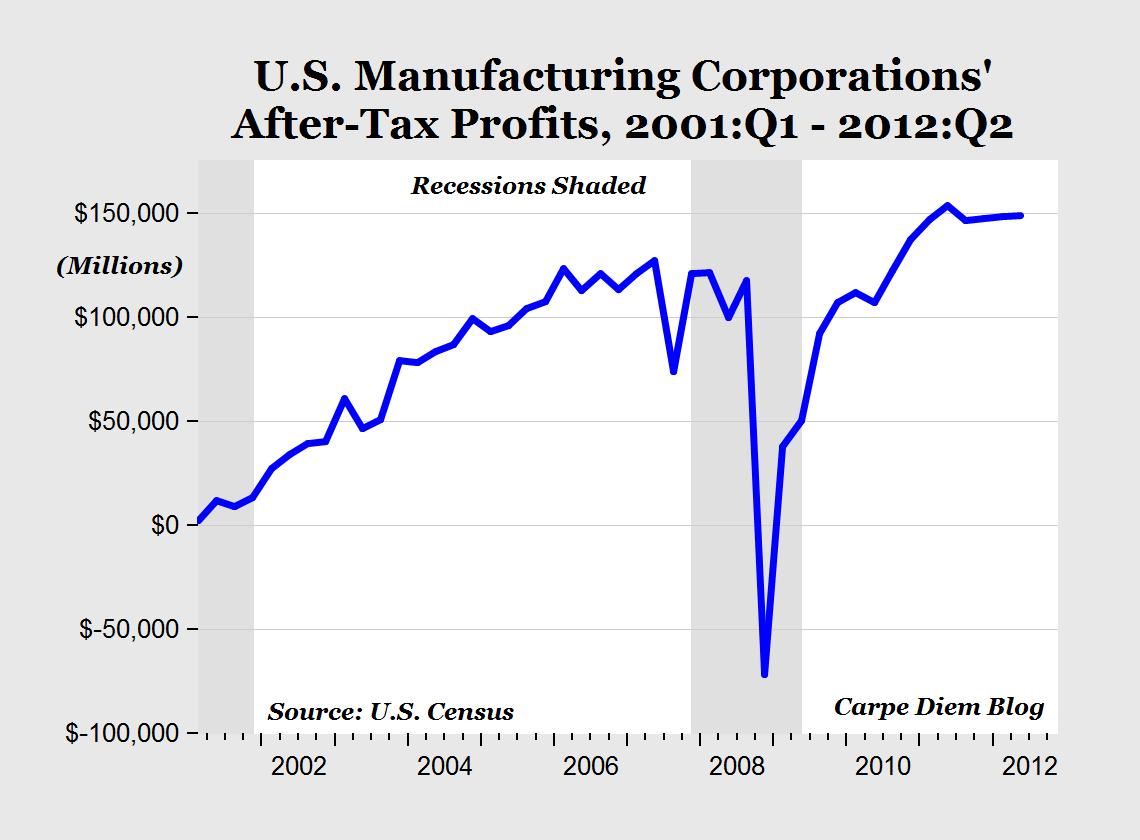
Mfg. Profits Are 35% Above Pre-Recession Levels

Mfg. Profits Are 35% Above Pre-Recession Levels:
U.S. manufacturers had another solid quarter of profits from April to June, according to data released today by the Census Bureau.  The total after-tax profits for American manufacturing corporations totaled more than $149 billion in the second quarter, a slight increase from $148.2 billion in the first quarter of 2012, but down slightly from the all-time quarterly high of $153.4 billion of profits in the second quarter of 2011 (see chart above).  

Manufacturing profits have ranged between $146 billion and $153 billion over the last six quarters starting at the beginning of 2011, which contributed to record-setting profits in 2011 on an annual basis of almost $600 billion.  Based on the first two quarters of this year, manufacturing profits are on track to approach $600 billion again this year.  

In the three years before the recession started (2005-2007), manufacturing profits were averaging about $110.0 billion per quarter, so the recent average of $148.5 billion per quarter since 2011 puts current manufacturing profits 35% above pre-recession levels.  This provides evidence of an industry that has not only made a complete recovery from the 2007-2009 recession, but shows that U.S. manufacturers as a group are now actually significantly more profitable than before the recession.  

Friday, August 24, 2012

Silver is also set for a correction

Silver is also set for a correction:
Hi friends,

Like Gold, Silver is also set for a correction soon. Silver has rallied all the way from $26.60 to $30.50 today in exactly one month's time frame. Below is the chart showing its Stochastic RSI moves:-


According to Stochastic RSI, D is at 76.93 whereas K is at 92.38. I am expecting K to soon cross below D & confirm the sell signal.

Bollinger Bands on the other hand is also giving clear sell signal:-


The RSI is also in overbought zone now.... out of 3 RSI's 2 are already in overbought zone. Below is the chart showing all the 3 RSI's:-


In stead of RSI, I rely much on its stochastic moves, which I believe shows much clear pic.

So IMHO, this silver rally like gold should also fade out soon. Or max it can stretch little more which we often see happening with positive sentiments.

regards,
kiran..

Microsoft reveals new corporate logo for first time in 25 years

Microsoft reveals new corporate logo for first time in 25 years: NEW YORK, Aug 24 — Twenty-five years after Microsoft revealed their first corporate logo, the software company yesterday unveiled a new, more colorful design similar to that found on the company's Windows products.  The new logo features a multi-coloured symbol composed of four squares of blue, red, green and yellow, like the one found on ...


Facebook co-founder Moskovitz sold stock post lockup

Facebook co-founder Moskovitz sold stock post lockup: NEW YORK, Aug 25 — Facebook Inc co-founder Dustin Moskovitz sold 450,000 Class A shares over the past three days, his second such sale since last Friday, becoming the latest insider to sell shares following the end of the lockup, according to a regulatory filing late on Friday evening. Moskovitz, who was Facebook's first chief technology officer, ...


Monday, August 20, 2012

BSE | NSE gets 4th 5th place in emerging economies

BSE | NSE gets 4th 5th place in emerging economies:
Share |

So some good updates wrto Indian stock exchanges as Bombay Stock Exchange and National stock exchange got position in top 5 bourses for emerging markets.

Indian stock exchanges, Bombay Stock Exchange ranked fourth with market capitalization of 1,101.87 billion and National stock exchange followed with fifth rank as it has market capitalization of 1,079.39 billion. Out of total 14 bourses from emerging markets were ranked by World federation of exchanges. China and Brazil topped the list of emerging markets. Shanghai Stock Exchange topped with market capitalization of 2.4 billion dollars. Shenzhen Stock Exchange is second and Brazil's BM&FBOVESPA remained third.

However the not so good news wrto Bombay Stock Exchange is that it's net profit declined by 76% in last quarter. net profit of BSE declined to 15.4 crores only.

Technology Stocks, Including Baidu, Making Big Moves on August 20, 2012

Technology Stocks, Including Baidu, Making Big Moves on August 20, 2012: This morning's trading has marked a bad day for the market so far. The Nasdaq has slipped 0.2%; the S&P 500 has decreased 0.3%; and the Dow is trading down 0.2%. The technology sector is a category of ...

Thursday, August 16, 2012

Lenovo beats estimates with 30p Q1 profit rise

Lenovo beats estimates with 30p Q1 profit rise: HONG KONG, Aug 16 — Lenovo Group Ltd, the world's No.2 PC maker by sales, posted a 30 per cent rise in quarterly net profit, beating forecasts, though it logged its weakest growth in 1-1/2 years as China's economy slows. Lenovo, which ranks behind Hewlett Packard Co in PC sales, posted a net profit of US$141.367 million (RM424.1 million) for its ...


July Industrial Production Highlights; Factory Output Is Growing at 2X Rate of Overall Economy

July Industrial Production Highlights; Factory Output Is Growing at 2X Rate of Overall Economy:

The Federal Reserve released its report this morning on Industrial Production in July, here are some highlights:

1. Overall industrial output increased by 0.6% in July on a monthly basis, and by 4.4% on an annual basis, marking the 30th consecutive month of annual growth.

2. Annual increases were especially strong in July for business equipment (12.3%), motor vehicles and parts (26.5%) and overall manufacturing (5.0%), especially for durable manufactured goods (9.5%). 

3. The Federal Reserve reported motor vehicle assemblies of 11.01 million units in July (seasonally adjusted, annual rate), which was an increase of 29% over last year and the highest number of monthly assemblies in more than five years, going all the way back to June 2007 (see top chart above). Look for strong gains in vehicle sales to continue through the summer and fall, especially since banks are showing a new willingness to make car loans, see Monday's WSJ article "A Green Light for Car Loans" about the recent car-financing surge. 

4.  July's index for business equipment was just slightly below June's level, but was up by 12.3% compared to a year ago, and the index level for that market group of 104.5, is now slightly above the previous pre-recession peak in February 2008 of 104.4 (see chart above).  The transit component of the business equipment group registered the strongest annual gain in July at 28.1%.

MP: Overall, today's Fed report suggests that America's industrial sector continues to grow and remains at the forefront of the economic expansion - the June 2011-June 2012 growth rates in industrial production of 4.7% and 5.6% for factory output are more than twice the rate of growth in the overall economy of 2.2% for real GDP during the same period. Nothing in today's report on industrial output in July would suggest that the U.S. economy is on the front edge of a recession, especially with the strong performance for the production of auto assemblies (now at a five-year high) and business equipment (reached an all-time high in June), and the strong gains for durable goods manufacturing of 9.5%.

Update: From Scott Grannis, "The July industrial production numbers all but rule out the recession that many have been looking for. The economy went through a bit of a soft patch in the first half of this year, but now looks to be picking up. The folks at ECRI have a lot more 'splainin to do."

Graphing The Huge, Exponential Bakken Boom

Graphing The Huge, Exponential Bakken Boom:
Click to enlarge.
The chart above shows just how important the Bakken region of North Dakota has been to the state's exponential growth in oil production over the last six years.  As a direct result of fracking unconventional shale oil in the Bakken, North Dakota went from the fifth-largest oil producing state in 2007 to the second-largest oil producing state this year, after surpassing Oklahoma in 2008, and then both California and Alaska this year.  It's amazing how just one oil field in western North Dakota and eastern Montana has transformed the energy landscape of North America.   

HT: The chart was inspired by a similar one at the EIA's website. 

The Higher Education Academic Conference Racket

The Higher Education Academic Conference Racket:
At the risk of being accused of exposing one of higher education's "dirty little secrets," let's have a frank discussion about the market racket? for academic conferences.  This post was inspired by an email invitation I received today to attend an academic conference in Costa Rica next March at the Marriott Los Suenos Ocean Resort and Casino in Herradura, Costa Rica (pictured above).  It seems like I get one of these unsolicited invitations every week for an academic conference somewhere in the U.S. or overseas.  Here's how this "academic conference racket" works:

1. Promotion from assistant professor to associate professor with tenure at most universities is primarily based on publications in academic journals and presentations of research at academic conferences (which often then lead to publications).  Sure, teaching counts too, but marginal, below-average teaching can usually be offset by a strong publication record (but not vice-versa). 

2. Promotion from associate professor with tenure to full professor is also primarily based on academic publications and presentations at academic conferences.  Sure, teaching counts, but see above.  

Therefore, there is a HUGE demand from thousands of tenure- and promotion-seeking professors across the country (and around the world) to attend academic conferences, present their research, and then hopefully have that research subsequently published in an academic journal or in the conference proceedings, or sometimes both. Publications lead to tenure and promotion, and often large pay increases of $8,000 per year for promotion to associate professor, and $10,000 for promotion to full professor (those are the current increases at UM-Flint).  Another factor that increases the demand for academic conferences is that all travel expenses, conference fees, and meals are generally paid by the professors' academic institutions.   

That explains the demand side of the market, which as I said is HUGE.  Now what about the supply side?  Of course, it's grown to meet the high demand and it's no surprise that there is a large and growing "academic conference industry," along with a large and growing industry for academic journals to publish academic research (which is typically ignored, except for a few other academics).  

The National Business and Economics Society (NBES) is sponsoring the conference in Costa Rica and is just one of hundreds of academic organizations on the supply side of the academic conference and publishing industry.  Previous NBES conferences have been held in Hawaii (every other year), the Lesser Antilles, the West Indies, Puerto Rico, Mexico, the Virgin Islands and Key West (and never in Duluth, MN, Sagniaw, MI, or Buffalo, NY).  See a noticeable pattern?  Hold an academic conference in early March in an exotic location like Costa Rica, and professors will flock to those events, with all expenses paid for by their university students and/or taxpayers.  Let's be realistic, don't professors deserve a "Spring Break" getaway around the time their students are heading down to Daytona Beach or Miami Beach?   

Now, to attract the greatest number of scholars to an academic conference in an exotic location in March, should the organization make the academic focus of the conference broad or narrow?  Obviously, it should be as academically diverse as possible, and the NBES isn't holding back, it invites scholars from Finance, Accounting, Marketing, Management, Information Systems, Operations Research, Economics, Public Health and Administration, Psychology and related areas.  Wow, that's every department in the entire business school plus some almost unrelated departments in the College of Arts and Sciences! 

While they're on their all-expenses-paid trip to the four-day conference in Costa Rica (often with a spouse, who pays airfare but usually not for the accommodations), the professors can take advantage of a host of activities in Costa Rica during their ample free time (their academic obligation may only involve one 30-minute research presentation, or maybe one other session where they serve as a discussant) that includes shopping, dining, deep sea fishing, water sports, hiking, golf, tennis, and an on-site casino.

For the last four years, the NBES has published electronic "conference proceedings" (password protected) of the papers presented, which could count as an academic publication for some universities.  In that case, the professor gets credit for presenting academic research at a conference in Costa Rica and possibly for an academic publication for his or her paper in the conference proceedings, and that research may eventually lead to an academic publication, which may eventually lead to promotion, tenure and a large increase in salary. 

In the end, students (or their parents or taxpayers) ultimately pay for their professors to attend academic conferences in places like Costa Rica in March, and contribute to rising tuition and the "higher education bubble."  And it's not clear that students reap any benefits from these academic conferences relative to the costs, especially if the trade-off is lower tuition and fewer academic conferences, or higher tuition and more academic conferences.  The fact that community colleges typically charge tuition that is about 50% of a four-year university might partially be explained by the fact that professors at community colleges aren't under pressure to publish, and don't attend expensive, four-day academic conferences in Costa Rica, Hawaii and the Virgin Islands with the same frequency as their counterparts at 4-year colleges.    

Academics: Am I being unfair or inaccurate? If so, please respond. 

PETDAG Continues To Move Up To Support FBMKLCI

PETDAG Continues To Move Up To Support FBMKLCI:
PETDAG continues to move up this few days to push the index to new high. You may see all the Petronas share is moving to new high in history.

As long as the election date not been fix, I think PETDAG will continues to move higher. However, this show that Malaysia share index is very easy to manipulate by government.

BSE | NSE gets 4th 5th place in emerging economies

BSE | NSE gets 4th 5th place in emerging economies:
Share |

So some good updates wrto Indian stock exchanges as Bombay Stock Exchange and National stock exchange got position in top 5 bourses for emerging markets.

Indian stock exchanges, Bombay Stock Exchange ranked fourth with market capitalization of 1,101.87 billion and National stock exchange followed with fifth rank as it has market capitalization of 1,079.39 billion. Out of total 14 bourses from emerging markets were ranked by World federation of exchanges. China and Brazil topped the list of emerging markets. Shanghai Stock Exchange topped with market capitalization of 2.4 billion dollars. Shenzhen Stock Exchange is second and Brazil's BM&FBOVESPA remained third.

However the not so good news wrto Bombay Stock Exchange is that it's net profit declined by 76% in last quarter. net profit of BSE declined to 15.4 crores only.

Tuesday, August 14, 2012

German, French GDP data lift European shares

German, French GDP data lift European shares: LONDON, Aug 14 — European shares and the euro rose today as slightly better than expected performances by the German and French economies in the second quarter eased anxiety about wider euro zone data that are likely to show the bloc sliding back towards recession. After worrying China trade figures on Friday and yesterday’s report showing a ...